HVAC capacitor problems cause your air conditioner or furnace to struggle at startup, run inefficiently, or shut down completely without warning. Identifying AC capacitor issues early prevents compressor damage and keeps your system running through the hottest and coldest days of the year. A bad HVAC capacitor cannot store or release the electrical charge your motors need to start and run. Furthermore, a failing AC capacitor delivers inconsistent power that strains the compressor and blower motor with every cycle. HVAC capacitor replacement restores full power delivery and eliminates the startup failures that leave your home without heating or cooling. In addition, knowing when to replace an AC capacitor prevents you from paying for unnecessary compressor or motor repairs when the capacitor was the real problem. Recognizing HVAC capacitor symptoms helps you act before a weak capacitor causes expensive secondary damage.
Likewise, knowing the signs like HVAC capacitor symptoms of a bad AC capacitor saves you from misdiagnosing the problem as an opener, thermostat, or motor failure. If your AC hums but does not start, search for HVAC capacitor problems near you to get a fast professional diagnosis.
What an HVAC Capacitor Does
An HVAC capacitor and its HVAC capacitor symptoms is a small cylindrical component that stores and releases electrical energy to start and run motors in your heating and cooling system. Specifically, understanding how capacitors work helps you recognize when one is failing and causing AC capacitor issues.
Here is how capacitors function in your HVAC system:
- Start capacitors deliver a burst of energy to get the compressor or fan motor spinning
- Run capacitors provide continuous energy to keep motors running at the correct speed
- Dual capacitors combine start and run functions for two motors in one unit
- The compressor, condenser fan motor, and blower motor each depend on capacitor power
- Without a functioning capacitor the motor cannot overcome its starting resistance
- A weak capacitor causes the motor to draw excessive amperage which generates heat
Because capacitors handle high voltage and degrade over time, they are one of the most common HVAC components to fail. Therefore, capacitor problems account for a significant percentage of all air conditioner service calls.
Signs of Problems
HVAC capacitor symptoms are distinctive and help you identify the problem quickly. Furthermore, recognizing the signs of a bad AC capacitor prevents you from running the system in a damaged state.
Here are the most common signs of HVAC capacitor problems:
- The AC unit hums or buzzes but the compressor or fan does not start
- Also, the system takes a long time to start up after the thermostat calls for cooling
- Furthermore, the AC shuts off randomly before reaching the set temperature
- The outdoor fan spins slowly or not at all while the compressor runs
- Additionally, you notice a burning or acrid smell near the outdoor unit
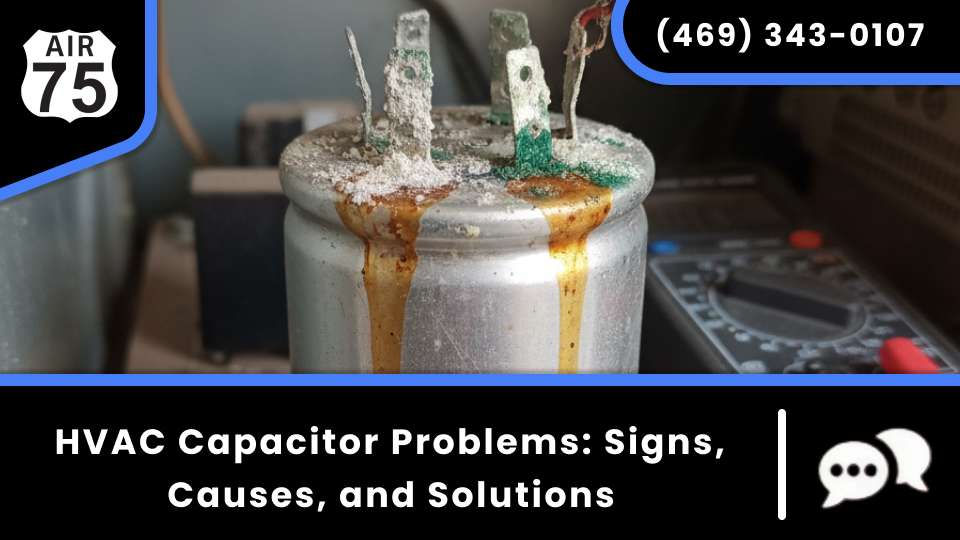
- The capacitor housing appears swollen, bulging, or leaking fluid on top
- Energy bills increase without changes in usage because motors run inefficiently
- Finally, the system trips the circuit breaker repeatedly during startup attempts
A bad HVAC capacitor often mimics compressor failure because the compressor cannot start without capacitor power. Consequently, many homeowners assume the compressor has failed when a 20-dollar capacitor replacement would fix the problem.
What Causes HVAC Capacitor Problems
Several factors cause AC capacitor issues to develop. Specifically, understanding these causes helps you extend capacitor life and prevent premature failure.
Heat exposure Capacitors degrade faster when exposed to excessive heat. Consequently, outdoor units in direct sunlight and poorly ventilated equipment rooms accelerate capacitor wear. Furthermore, a failing AC capacitor often fails during the first heat wave of summer when demand peaks.
Age and normal wear Capacitors have a finite lifespan regardless of conditions. Furthermore, most HVAC capacitors last between 10 and 20 years under normal use. In addition, capacitors lose storage capacity gradually so performance degrades before complete failure occurs.
Power surges and voltage fluctuations Lightning strikes, utility grid fluctuations, and power outages damage capacitors instantly or weaken them over time. As a result, homes in areas with frequent storms experience more capacitor failures. Furthermore, a surge protector on your HVAC system prevents most electrical damage.
Overworked motors Dirty coils, restricted airflow, and low refrigerant force motors to work harder which draws more current through the capacitor. Consequently, the extra electrical load accelerates capacitor degradation. In addition, a system that short cycles puts repeated startup stress on the capacitor.
Short cycling and frequent startups Systems that turn on and off rapidly put repeated startup stress on the capacitor. Furthermore, every startup demands a surge of stored energy that wears the capacitor slightly. Consequently, a system that short cycles due to an oversized unit, dirty filter, or refrigerant issue degrades capacitors much faster than normal operation for no AC capacitor issues.
HVAC Capacitor Replacement Process
HVAC capacitor replacement is one of the fastest and most affordable HVAC repairs. Furthermore, knowing when to replace an AC capacitor and what the process involves helps you plan the service.
When replacement is necessary:
- The capacitor tests below its rated microfarad value on a multimeter
- Also, the housing is visibly swollen, cracked, or leaking oil
- Furthermore, the system will not start despite power reaching the unit
- Motors hum without turning after verifying the contactor works
- Additionally, the capacitor has failed a start test performed by a technician
What professional replacement involves:
- The technician shuts off power and discharges the old capacitor safely
- They test the existing capacitor with a multimeter to confirm failure
- They install a new capacitor with the correct microfarad and voltage rating
- They verify motor amperage is within specification after installation
- They test the system through a complete startup and cooling cycle
- Finally, they inspect contactors, wiring, and connections for related damage
HVAC capacitor replacement costs between 100 and 250 dollars including parts and labor. Furthermore, the capacitor itself costs between 10 and 30 dollars while labor accounts for the rest. Consequently, this is one of the most affordable fixes that restores full system operation.
How to Prevent HVAC Capacitor Problems
Preventing capacitor failure extends the life of your entire HVAC system. Furthermore, most AC capacitor issues are preventable with proper maintenance and protection.
Here are effective ways to prevent HVAC capacitor problems:
- Schedule annual professional maintenance that includes capacitor testing with a multimeter
- Also, install a surge protector on your HVAC system to prevent electrical damage
- Furthermore, keep the area around the outdoor unit clear for proper airflow and heat dissipation
- Change air filters regularly to prevent motor strain that overloads the capacitor
- Additionally, provide shade for the outdoor unit without restricting airflow
- Address short cycling and other performance issues immediately before they stress the capacitor
- Finally, clean condenser coils annually so the compressor does not overwork
These preventive steps protect your capacitor from the heat, electrical stress, and motor overload that cause premature failure. Consequently, a well-maintained system keeps capacitors running for their full expected lifespan.
When to Call a Professional
Capacitor work involves high-voltage components that can cause serious injury. Therefore, contact a technician for HVAC capacitor problems near you if any of the following apply:
- Your AC hums but the compressor or fan does not start
- The system trips the breaker during startup
- You smell burning near the outdoor unit
- The capacitor appears swollen or is leaking
- Your system shuts off before reaching the set temperature
- You want a capacitor test during routine maintenance
An HVAC capacitor problems expert near you tests the capacitor, verifies motor amperage, and replaces the failed component with the correct rated part. Specifically, they check all electrical connections and test the full system before leaving. In addition, they identify any motor or contactor damage caused by the failed capacitor.
Do not let a cheap capacitor failure destroy your expensive compressor. Instead, call today to schedule your capacitor diagnosis and restore reliable operation to your HVAC system.
Phone: (469) 343-0107
Email: info@air75hvac.com
Website: https://www.air75hvac.com/